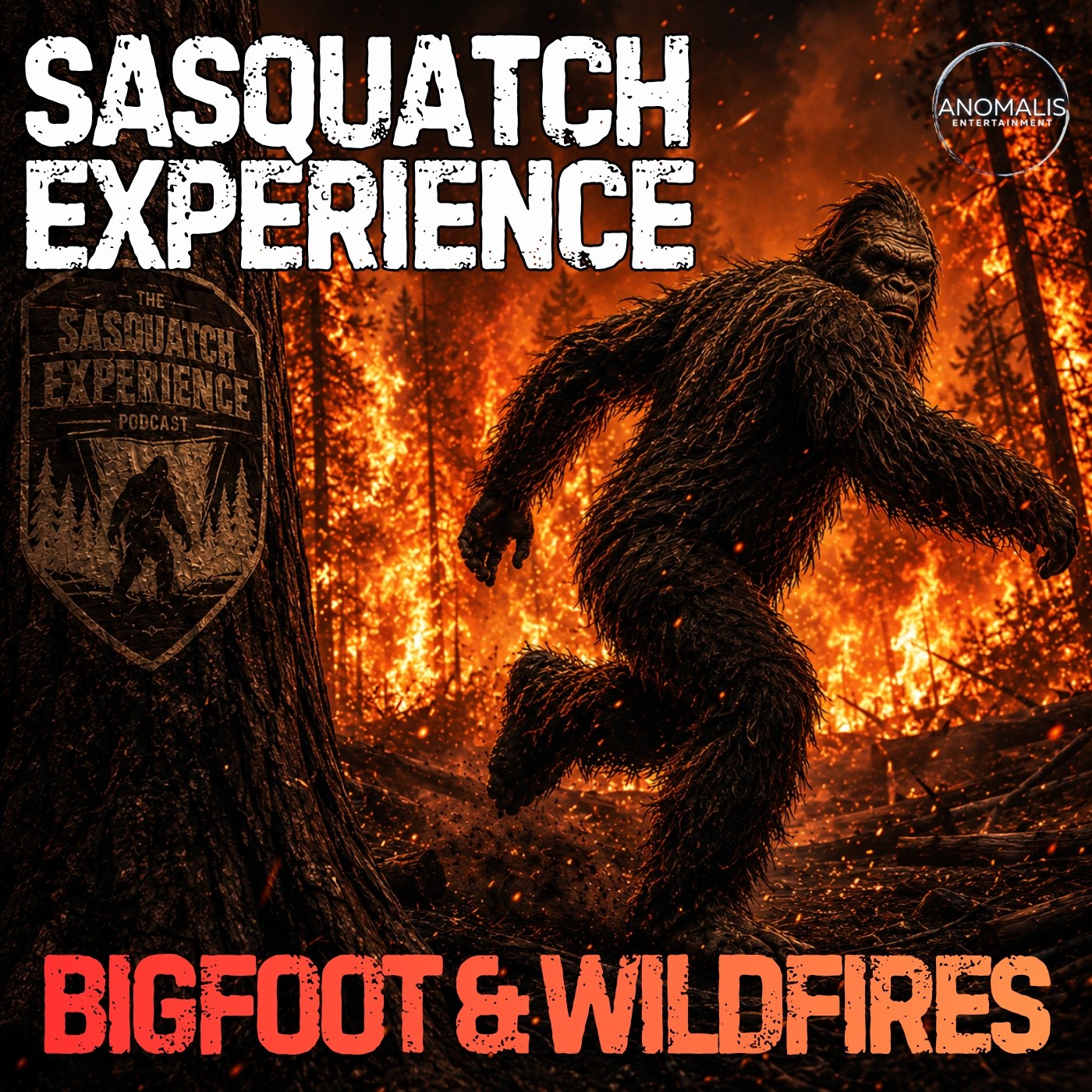
Wildfires
with The SE Crew · Sasquatch Experience
GET YOUR SASQUATCH EXPERIENCE GEAR FROM THE SQUATCH PRO STORE!
Sean Forker hosts SASQUATCH EXPERIENCE, which also features Matt Arner, James Baker, Vance Nesbitt, and Henry May.
Creative Consultants:
Matt Knapp (Bigfoot Crossroads) & Les Sincavage (Xplorers: Seekers of the Truth).
Show Executive Producer:
Brian Corbin
Special Thanks to all our Patreons:
The Experiencers: Jeffreylee Matthis, Got Knockers!, Larry Sharpe, Scott Dieterele, and Tom Mihok
Trackcasters:
Cindy Brewer
The Hollers:
Gail Frederick, David Hickernell, Matt Arner, Laurie Nelson, and Lori Worthington
Without their support, this show would not be possible. For as little as $2 per month, please consider becoming a supporter on PATREON.
Our show intro music, “It Comes At Night” by Adam Dib, is licensed to us for commercial use. “9-11 Bigfoot Call” is also used under Fair Use. Sean Forker and Gabriel Forker are credited with the intro and exit voiceover work. Sasquatch Experience Trailer music, “It's in the Fog” by Darren Curtis, is used with permission and attribution.
If you’d like to hear a particular topic or guest, EMAIL US!
Check us out:
Facebook | X | Instagram | SasquatchExperience.com
- 00:04Show open, disclaimer, and technical hiccup with the live stream
- 01:05Sean welcomes the crew and introduces the Bigfoot-and-wildfires topic
- 05:11New sighting reports, research team updates, and Class A encounter talk
- 10:27Moon phases, vocalizations, and data-driven Sasquatch patterns
- 24:54Can wildfires push Sasquatch out of hiding or deeper into the woods?
- 32:02Battle Mountain, Nevada fire encounter from The Locals book
- 44:26Prey displacement, food sources, and why sightings may increase after fires
- 50:36Controlled burns, forest recovery, and final thoughts on wildfire ecology
Views and opinions expressed by the guests of Sasquatch Experience do not necessarily reflect the opinion of the hosts, sponsors, or affiliates of the Sasquatch Experience. As always, listener discretion is advised. 911, what are you reporting? We got someone or something crawling around out here. Did you see what it was? Was it a person or an animal? I can't tell. All I know is that my sensor light came on and I just happened to glance and see this thing running across the yard. A good-sized man or something that looks like a man. I don't know what it was. Back in 2005, we set out with one goal, to give voice to the mystery and those who pursue it. Sasquatch Experience Podcast has been your go-to source for serious Bigfoot discussions. where we separate fact from folklore, always grounded in research and respect. We've interviewed eyewitnesses, experts, and skeptic alike, because understanding Bigfoot isn't just about belief. It's about the journey. Nearly two decades later, we're still chasing shadows and sharing stories. The search never stopped. Welcome to the Sasquatch Experience. Jesus Christ, you better. Sheriff? See ya! Hello? Get somebody out here. And folks, we apologize for the delay tonight as we had an unusual situation there with the audio. I know myself, Matt Arner, Henry are here, Baker's there. But whether we can hear him or not, I don't know. He can still wave and pantomime and everything else he'd like to do. But, well, easy. I don't know what that was. And hopefully nobody else did either. Folks, I'm Sean, the Fork Shop Forker. I'm your host here on the Sasquatch Experience. And tonight we've got a great show for us. We're going to be talking about Bigfoot and wildfires. And quite the point of topic right now with, as we've all kind of dealt with these in one form or another, Baker. Rather, you're getting the smoke from the wildfires coming through your state Providence locale. I think the air quality is diminished for quite a few of us there for a little while, but it seems to have started to clear up a little bit. But interesting topic nonetheless. But before we get started, guys, one, how the hell are you doing? It's great to see you all this week. No. Blay. Go ahead, Henry. How are you doing, buddy? I'm good. Like I said, I can't complain. We can. We don't care, but you can complain. Henry, our 20th year of Sasquatch experience, by the way. 20 years. 20 years. Can you believe we've been together that long? Actually, we've been together longer. Yeah. We're like a married couple. Right. Baker's got the snaps, I guess. All right. I was testing the mic. I'm good. Oh, there we go. The Canadians took my voice when they added the smoke. Blame Canada. We've gone back to the blog talk radio days a little bit with the technical issues tonight. You know, everybody's using a different streaming platform and we've stayed here. We were stream yards and we moved to stream labs and I don't know if it's any better, but nonetheless, I think we were able to get it started. And of course, we have our good listeners in the chat. Folks, we always depend on you to tell us how we're doing. We got our producer, Brian Corbett, hanging around. One of our number one super fans, Jay Charlotte. Good to see Jay here. And of course, Mr. Scott Dieterle, our man of the hour, man of the power, always supporting us no matter what we do, where we go. He's there in the mix letting us know how we're doing. And we appreciate each and every one of our supporters greatly. And I'm being told to pump up the jams. Pump it up. Pump it up. There we go. All right. And Matt, man, I know it's been a day for you, buddy. How you doing? I'm doing good. I'm doing good. It was a rough day at work, but we got through it. And, you know, just looking forward and... I left for work today. I had the heat on in my truck. In the 60s here. When I left this morning. Wow. Yeah, it was beautiful. And you know what? When that weather starts to cool, there's all sorts of animals that are on the move. Yes, sir. And this is when we generally start getting good reports between August through November. Right. Right. Now is the time, and I'm pretty much all set to do some backcountry exploring this fall. Well, you know, Matt, like I said, we've had no shortage of reports since the Central PA Bigfoot Conference, our festivals. At least a dozen reports have come in. And we had one of the newest members of what I'm calling the Sasquatch Experience Research Team, Brianna, who was kind of keeping us abreast of that sighting report that came in for the gentleman we're calling Randall, she actually went on site and did an investigation. And I'll tell you guys, we're going to have a full workup on that probably next week to the listeners. What we're trying to do on days where we're opposite having a show, Mondays we're opposite, we're going to put in one of the sightings we've investigated and kind of get some of the information out there to kind of keep you guys engaged and titillated with what's going on here at the Sasquatch Experience. Because keep in mind, We're not just a podcast. We're an investigation service. And we go out there and we take all these claims seriously. And we go out and provide it with excellent, you know, just top notch investigations. We're skilled. We have people we network. So if we can't get out there in a timely fashion, be rest assured, whoever we're going to pass you off to is going to be a qualified person. We feel that someone's going to take your report and be able to treat it with as much seriousness as we would. So. They have our stamp of approval, hence the Sasquatch Experience Research Team. And I'll be glad to get a workup. Brianna said I had full permission to post it. And Matt, you and I will work on that as we continue to work on our book, A Loose and Proof, coming to you soon at some point. All right. I'm done talking there for a minute. Go ahead, Matt. Finish off where you were. It got cool. And then I went on. Yeah. So now, like I said, the reports are coming in. Uh, we're, it's not just prints or, uh, howls or, you know, your typical class B, but, uh, it was exciting to actually hear from a class A sighting that, that literally just occurred. Not only that, but going back to our small town monsters, uh, production of investigation Bigfoot, that was probably within 10 miles. of where the cabin was where we were staying at. And unfortunately I had to leave the night before, but, uh, or the day of when you guys had all that, um, uh, you know, all those, uh, uh, things going on. But, uh, it really, you know, if you're looking at it on, on a, on a face value, you have, you know, us going out there last fall, having, you know, some sort of experiences out there. Then you have, you know, now in August, you have a Class A sighting. During the Marionville Forest County Bigfoot Festival, just a number of locals came up to us and were telling us about, you know, the Class B encounters that they're having. We do try to rule out a lot with the howls. Is it an owl? Is it a coyote? Now we've got to deal with fisher cats here in Pennsylvania. Yes, sir. Could it be one of those three? Which fox? Fox make that female screaming sound. What does a fox sound? There it is. There it is. But we go through and. And out of these reports that we get, I'd probably say that there's about 15%, 15% to 20% that we just can't say for sure. We can't say that it's this or that or a coyote, an owl. And those are the ones that are unexplained. And then when you have other encounters, whether it's somebody seeing a print We had a lot of people come up to us and tell us about they had heard noises, they heard the footfalls, but then they had that odor that hit them. So the odor is definitely something that is enticing as well when it comes to the research for data. So we're putting all that together. We have some great people that we're working with. you know, we have, um, uh, you know, the, uh, the data, um, a person from Georgia, we have Mondo, um, and a few others that are, are putting all this, data together to try to come up with some sort of, uh, you know, uh, some sort of, I can't say it's conclusive, but, but just something there that, that we could say, okay, when, uh, during August, uh, during this moon phase, during this weather pattern, uh, you know, this is more likely to appear. And speaking of which, too, I was talking with the guys from Study Sasquatch. Great, great guys. And Chris Spencer, in one of his videos, had put out a really interesting hypothesis about vocalizations, wood knocks. And he said, look at the moon phase. And he thinks that when it's dark, when the moon is in a new moon phase and it's dark out, that these creatures probably are closer together when they're on the hunt. When it's a full moon, when it's a waxing crescent, waning crescent, and that light is out there, that's when they're getting vocalizations, wood knocks and such. And he believes that it may be from them being more spread out, you know, because of the illumination factor. That's something I've always hypothesized too, Matt, is that, you know, I think the allure of a full moon makes everything spooky and exciting and whatnot. But I don't think it makes sense for an animal that depends on the cover of darkness to move to be so... Correct. active during a full moon uh and then if you look at the time of year like specifically you and i have always said how our area is incredibly active from the end of august through fall partner that with moon cycles and what do you see when do we see the most activity so that's what we're looking at and the more and more we feed to mondo you know our data guy the more and more he's able to uh really put it together. And I told you at the last festival we were at there and, uh, and, uh, Sealand's Grove, Susquehanna Valley Mall, Gwen's event, uh, Gwen Purcell, uh, he put that data out there for the public. And I was like a kid in a candy shop. Like I couldn't get enough of that. I had to keep stopping myself from interjecting in his presentation because I was just absolutely enthralled by what the data was showing that not what our Gut was, and not what our, you know, any of those things. I was excited by what the data was showing that he pulled out from the witness reports. Now, we know there's always room for error with data, right? You know, because it's witness reports. It's not infallible. That being said, still pretty good with what we've got. Bake, you were going to say something, and then we'll jump back to you. One, I wanted to say that that was a really good conference we had at the Susquehanna Mall. I liked a lot of the speakers. Never let Mondo give you a Mexican strawberry. Just going to put it out there. Brian, you're forgiven, by the way. One thing I would say is we also are looking at the opposite of the data. Everybody's looking at this data proves this exists, this data proves this exists. But also when you look at some of the data that they've collected, you can also say that it can't be a bear or it can't be a deer or it can't be a muskrat or it can't be something else. The data isn't just 100% proving it has to be a cryptid. It's proving that we don't know what it is, but we definitely know it's not a woolly mammoth. I know it's an extreme to say it, but if you think about it, the data they've been collecting, it's the same data that I collect when I'm up at my land or me and Forker go out for a stroll or something like that. We get, okay, we heard a noise. Okay, well, it can't be this, can't be this, can't be this. And that's the data you also need. We had a gentleman that came with his parents and he wanted to become a cryptozoologist. I said, first of all, no. Go outside and suck in nature. You know, go do some hikes, some other stuff. I said, get an idea what nature is before you think you saw something. Because that'll help you realize whether you saw something or your friends are too stupid to realize it's a skunk coming your way. And there's a story to that. Yeah, we have firsthand account of that one. You know, the guy who couldn't watch, the guy who fell in the hole could modify, could tell that that was not a bear or an elk or a Bigfoot coming at us, but a small animal. Wasn't sure it was a skunk, but knew damn well it wasn't a bear. So, I mean, this data that. They're collecting is not only just proof there's something odd out there, it disproves other things it could have been. I guess that's my on that. No, very good. Very good. We do have a full episode here, though. We may actually have to create a part two for it because it's almost 20 after nine already. We'd be doing the bullhorn advancements here. Vance is on assignment tonight, by the way. Just a note, though, upcoming on September 12th, myself, James Baker, and potentially Matt Arner will be in attendance at the Bigfoot and Bluegrass Festival in White Deer, Pennsylvania. I'll be speaking, but if those two are there, they'll also be with me. So you get a, uh, you get a, uh, at least a twofer or a threefer for your money folks. It's always a good time when we present together. We're, we're very interactive. It's, it's a great time. Usually there's wine taste. There's a much better. What's that Matt? There's a much better chance that I will be attending. Oh, very good. That'll be exciting. Cause we mentioned whiskey. Uh, I know, I know. This is the first one you've missed at the Central PA. And, you know, but unfortunately. And I'm bummed out. I know. We were bummed out, too. But I really, I just sent my chair flying backwards because I really wanted you to see Mondo's presentation. It was amazing. I had a lot of fun at that. And anybody who was in attendance, I think, likewise, enjoyed that part. Thunderbird. I won an archery contest up in Elk County, so I had to go up and get my $ 500 gift certificate. Money! Yeah, two cellular game cameras, an elk target for archery, and an elk dartboard, which was actually pretty neat. An elk target? Is it like full size? Does it got the horns? No, it's actually a third the size. It does have the horns. James, I will get a picture for you tomorrow and send it in our group chat. A third-sized elk is still like, what, a deer target almost? It's a little bit bigger than a deer target? Yeah. Those things aren't cheap. It's the size of a deer. No, they're not. Those things aren't cheap, though. Wow, that's a good job. That's better than what I got for my 20 years at work. And listen, guys, whenever we go somewhere as a team and Baker and Matt either enter the contest or they raffle, one of them always wins. Sometimes between the two of them, they win almost everything. Oh, yes. And there's anger. Yeah. There it is. We're like, did Baker play? And I'm like, hey, man, I played. Last week, a week and a half, and it was really sad to me. Henry's announced his retirement from touring. He's not going to be doing conferences anymore. Is that right, Henry? Yeah. Yeah. Yeah, that's true. Yeah. Well, I mean, Henry, you've been doing them for how long? Like 20, 25 years you've been going to these? 18 years. I went to 18 events. That's pretty, that's pretty round number. That's a pretty, that's a pretty rough number. And, uh, Well, we're going to miss you at these Henry, but we are going to get the cardboard cut out of you there so people can still get their pictures taken. I just want to interject. Go ahead. I do want to interject that there was somebody that was asking about speakers for a national Bigfoot conference and everyone's up there promoting themselves or promoting this person, that person. And I, I put up there, I said, listen, I said, if you're going to do a National Bigfoot Conference, you'd need one of what I consider the big three in Bigfoot historians. And that would be, number one, Todd Prescott. Number two, Daniel Perez. And number three, our own Henry May. And so hopefully they get a hold of you. So if they offer this, come out to the National Conference. Come out for that one. I think those are the big three, I think, in the Bigfoot world today is Henry, Daniel, and Todd. No, Matt doesn't whore me out, Baker, because he ends up going along with me. So it's not like we always give people the bang for their buck out of us. But, you know, Matt, you and Les were. I don't even get paid. I don't even get a billing. No, and you don't know pay attention to verbal cues either Matt and Les were featured on Eric Mental Investigates Bigfoot Jim Thorpe that's out now posted on our Sasquatch experience page go check it out I think you'll enjoy it Matt tell us a little bit about filming that experience how was that. Well I wasn't too happy about it because I The whole reason I was supposed to be there was to talk about the encounter that literally happened a quarter of a mile from where we were taping. And you know what? We got into this gentleman from Jim Thorpe who had a Class A sighting last August. Here we go in August again. And it was so similar to one of the reports that we got up in Luzerne County. which wasn't that far away. It's, and it's part of the Lehigh, uh, waterway system. And as the guys told me, I, I, the hair was standing on the back of my, my neck. Cause I, it was so similar to that experience. So I ended up talking about that and completely forgetting about the incident where the girl was washing dishes. And, uh, she looks out the back window and there's a gorilla staring at her. And then when she, uh, went to tell her parents, uh, Uh, everyone ran out and there was two big imprints, uh, in the, uh, mulch that was up by the, uh, or the kitchen window and the kitchen window is about six and a half feet up from the ground. So obviously it was something pretty big. And, uh, you know, that was the encounter I wanted to talk about and I totally forgot, but otherwise, Les did an awesome job. Yeah. Les did an awesome job, uh, uh, telling you about his encounters. We had, again, this gentleman who was riding on the Lehigh Trail between Whitehaven and Jim Thorpe, where he saw this creature. And that was a great experience. So it was. It was fantastic. But man, I wish I would have been able to Uh, tell that encounter about that, about that young lady that had seen the gorilla face. Yeah. Well, you know what though? And it happens when we get involved in these things and you know it because it happens to us on the reg. We're in there. We're going to talk about something else like tonight's show. And we ended up talking about something more that's pressing on our minds. Right. And, uh, even happened when we were filming a little bit, uh, when we were doing the investigation, Bigfoot deal, uh, uh, I mean, it's just part of it. You get into a good conversation, you get into a good rhythm, and then everything else goes out the window. But while we're talking about Small Town Monsters, there's a slight segue. August 30th, something that if you're a fan of Bigfoot, everybody needs to pay attention to. Go to Small Town Monsters on YouTube. Science and Sasquatch, the legacy of Jeff Meldrum. will be airing at 2 p.m. on Monday, August 30th. It's a Small Town Monsters special. I'm looking forward to that. We love our friends over at Small Town Monsters. Yeah, we have a little bit of bias, but they've always treated us well, but they always put out a top-notch production, and I think it would be nice to have something special done for Doc Meldrum. I mean, we were going to sponsor Dr. Meldrum at the Bigfoot camping adventure weekend. That didn't get to happen. That was a big pile of suck, as Baker would say. Very tragic for us. We didn't get that time. We did get Ron Moorhead, and it didn't turn into a weekend at Bernie's thing, so we were all right with that. Any weekend with Moorhead's better. But go tune in August 30th. 2 p.m., Small Town Monsters, Vines and Sasquatch, A Legacy of Dr. Jeff Meldrum. Of course, all these things will be posted on the Sasquatch Experience Facebook page. We do have a new website, SasquatchExperience.com. I took us off getting that up. It's a much better website for you guys to go and navigate to. And if you're so inclined, just as easy to go and become a member for $ 2 a month via our Patreon, which we're going to have a lot of our research stuff starting to post over there. I know we promised, promised, promised to bring you more content, but we have so much going on behind the scenes. I think you folks will be happy. The new website's just the beginning. A lot of stuff going on behind the scenes. Oh, I hear the train. I hear the train a-coming. There we go. It's a little late tonight. little league world series in full effect here in williamsport pennsylvania james baker and i are uh dealing with that uh just just a small inconvenience in our lives to bring so much joy to uh the world with little league being here in our own backyards but now let's get in the the crux of things i can't talk tonight the crux i i quit somebody else want to take over here uh You know, a central question I have for you guys when we get started into this, do you think these wildfires are pushing Bigfoot out of hiding? If Sasquatch is a flesh and blood animal in North America, what happens when thousands or millions of its acres are burning? Where do they go? Do they go closer together? Do they go further into the woods? What say you? Let's get some questions and some dialogue going on this. Go ahead, James. Well, it's a good question. Go ahead, Henry. We may not get the answer to it. Well, what do you think? Over all the years, Henry, you've done this. You've collected the stories, read the stories. What do you think? Why do we not get more sightings, or why do you think something hasn't been proven, given the nature of all these wildfires? Hmm. Hmm. Henry, you want me to take a crack at it? I don't know. You got it. Well, do it. Yeah, go ahead. Go ahead, babe. Okay. So my opinion on a lot of this is, and I've always had the two, I'm of the two schools of thought either. It's not real. And we've been, we've been, you know, hypothesizing or it's real and it's highly intelligent. I mean, the two, you know, have to kind of go together a little bit. I think the big thing with these wildfires and everything is... And I don't know if I have the name right, but I think it's Rene DeHinden. Was the one who studied the bears? No. No. Okay, Forker knows names. I know facts. Okay. So, he'll tell us in a minute when he's done pulling on whatever he's got over there. So, they. This person always looked at how do bears interact with their environment during certain times, certain moon cycles, certain things. John Mayanzinski was who you're looking at. John Mayanzinski. Thank you. Okay. But they looked at an animal that they could trustfully see and had things that were exact. Like a lot of the people look at the great apes and they go and they use that as a base. in the Pacific Northwest and, you know, the Dakotas and all that. And then the woods, you know, Pennsylvania woods, they look at the bears because it's a large enough animal and it would be affected by the same thing that a larger animal that was a carnivore slash herbivore would be affected by. So what you would look at is these California, Oregon, Canada wildfires. Even if the fire doesn't directly do it, I live in Pennsylvania and the fire was in Canada. And I still got some process during for like a week. So anybody that was in like North or South Dakota or Chicago, you know, Illinois, Chicago, all those places were choking for like a month. So these animals have, you know, if the animal is there, it has to be affected. And it's got to be, you know, finding places where it's clearer. I would think with the way smoke works and things like that, they would go to lower elevations. They would be closer to things that would block the wind. But again, if you look at a bear, you could see what their movements are and then you. Might be able to track. Because we're all one big guessers. That was the one thing I tried to point out to the gentleman that wanted to be a cryptozoologist. I said, A big portion of what we do is walking around the woods and guess, you know. So, I mean, I would say study bears in those local areas, see what they're doing. That might give you an idea of what's going on. All right, Henry, I'm sorry I cut you off. It's your turn again. No, no, no. I couldn't put a bear myself, babe. Matt, what say you, sir? I mean, I have a lot of things to say about, you know, with the wildfires first, it's not like people and we haven't emergency exit, you know, where you see all the deer coming out and all the elk coming out and all the bear coming out. They're scattered and they're scattering into the areas that aren't under the threat of wildfire. And with that, unless you had somebody encircling the, every 20 yards around a radius of a wildfire, you're not going to see every animal that comes out of it. So there's also ways that some animals will burrow to escape the wildfire. Again, you're getting very high temperatures, but in some of the wildfires, it's just burning off vegetation and wood, and it's not burning into the soil as much as it would maybe with like the California wildfires in Malibu where they were just, you know, just super high temperature numbers going into that. So they do, you know, they're going to escape. Animals are going to find their way to survive. The wildfires have been going on since we've had oxygen and everything else going here. So, animals know how to keep themselves alive during these times. We do have a question there from our panel. What do they do with animal carcasses that get burned up in wildfires? What do the state do? Well, I would think they would probably have some kind of machines that go through the grind up the trees and grind up everything and kind of almost like you'd be almost. Like a mass grave, you know, where you grind it into the ground. Well, here in Pennsylvania, you know, they pick up roadkill and they have, I don't know what you call them. Uh, body. Yeah. Body piles that they throw these carcasses in or as, uh, uncle Z likes to put it lunch. Um, uh, But they do, at least in Pennsylvania, they do collect the dead animals and dispose of them in large pits or what have you. In fact, we've had reports in Pennsylvania of these locations being visited by Sasquatch. So it's very interesting to think that. Well, and, you know, Brian, you kind of set me up to segue into one of my favorite encounters that Whenever I think of wildfires or, you know, big fires, and Henry, you'll probably relate right about that. Yeah, there was going. You do? Yeah. And you probably saw me pick up the book, The Locals, by Tom Powell. This has a great story in it. Tom Powell wrote this. And, of course, page 218, published by Hancock House. Let me just read the account. This compelling account was sent to the BFRO website on Sunday, August 8, 1999. Two days earlier, a complex of range fires was started by lightning strikes as convective thunderstorms formed in the hot, dry August air over Battle Mountain, Nevada. This area is a mining district riddled with abandoned mining tunnels and shafts. The juniper and scrubby sagebrush of the mountainous terrain around Battle Mountain exploded into several simultaneous range fires in what would eventually be known as the Battle Mountain Complex Fire. This is the report that the BFRO received before the fires even got large enough to make the news. This was 7 August 1999, Battle Mountain, Nevada. And the person writes, I observed an animal wounded by fire moving on all fours not like a bear, more like an ape. Firefighters captured animal, contacted local vet and medical doctor. U.S. Department of Fish and Wildlife, Department of Interior, Bureau of Land Management on the scene. Animal tranquilized and moved to unknown location. Those at scene told not to talk about what they saw. Approximate animal 7.5 feet tall, long, Human-like arms and legs. Face not like man or ape, but mixed between. Genitalia. Male. Uncircumcised and human-like. Hair. Covering most of its body except chest. Chest has hair, but sparse. Hands with sparse hair. Palms bare with five digits with human opposition of thumb in fifth digit. Speech. Attempted to communicate with caregivers once it realized they were attempting to careful. Multiple burns to hands, feet, legs, and body. some second and third degree burns using rule of nines, approximate 45% of body with burns. Doctor and vet working together providing care and moved it to unknown location. This notice is given in violation of orders given by BLM, DOI, and DF & W. Witnesses numbered in the area of 20 to 25. Word is out in the government agencies and among the firefighters since an MD was called out. Many thought a firefighter was injured. Please note that I am a government employee, one of the listed agencies fighting brush fire in Wilderness Area of Nevada. Large-scale fire, approximately 70,000 acres, burned. And under orders not to disclose information. I believe a cover-up is in the making. People need to know. The animal needs to be kept alive, studied, and released in protected area. So that was kind of like it was given in a pretty matter-of-fact kind of manner. Right. Somebody who works in law enforcement, does that sound like a report that came from somebody in law enforcement with syntax and, and the way it was communicated out very staccato? You know, I mean, it sounds like it would be a report written by someone that's in the, you know, emergency management, you know, first responder program, but I don't, I don't know. You know, I've, There's so many stories about, you know, from Mount St. Helens, you know, some of these other wildfires. And, you know, I think at some point there would have been a body, something recovered and, you know, made public at this point. Baker, I heard at home, what's your reservations? I think Matt hits the biggest problem that we all have. And we've had this discussion multiple times. It's nice to see that they mentioned it was a humanoid one, not a red rocket. But the other discussion we have a lot is, is that I don't ever think we're ever going to find a body by, there's not going to be somebody hunting Bigfoot and he shoots it in the woods or whatever. It's going to be Sally. Aunt Sally had a few extra margaritas and she hit something with her car and that didn't get her a homicide charge. And, and now she's a multimillionaire because in Texas, she's making money right left, you know? And, and I think that's how, if they find a body, that's going to happen. It's not going to be accidentally, or it's not going to be whatever, because. Well, that would be accidentally. Well, I mean, it's not, sorry. It's not going to be purposely. Gotcha. I don't think somebody walking out, you know, you know, it's kind of like, um, I was reading something about dinosaurs, and before the 1800s, they assessed that any bones they found that might be dinosaur-ish were the fabled dragons and some of the fabled creatures that were mentioned in the old books and stuff, until science said, no, no, no, that's a dinosaur. And the same with, like, we see the great apes and some of the other ones is, you know, We as human beings, you know, we weren't the only human type thing sharing the planet. We're just the ones that seem to flourish and survive better. You know, you look 200,000 years ago and they had the Cro-Magnon man and they had this man and, you know, this different forms that we kind of all merged together to, you know, the epitome of what we are now, you know. And I think that we either haven't found it right the bodies or like I said is that it's intelligent and it finds a way to get rid of them. You know just for the record James Baker is not a professional anthropologist so his human tree and the history of. You know that stupid little timeline that shows the little caveman and then shows the guy with the iPod. Yeah We're going backwards now, but whatever. And on behalf of the Sasquatch experience, we do want to apologize for all the Aunt Sallys out there that Baker just called alcoholics and may have committed vehicular homicide. You guys all have an Aunt Sally, and you're damn well she's a drinker. All right. Yeah, I think mine's a Doris. That's not nice. It's Ada. And Ada. Anyhow. Enabling. Enabling. Listen, at the event over the weekend, it was my sister that was the drunk. Remember? She's never going to forgive me for that. Anyhow, but this Battle Mountain, Nevada story, you know, we've talked about this for some time. And what's interesting to me is it didn't seem like there was any kind of real hoopla about it. You know, we, you know, Henry, 1999, Internet was still consistent. of just getting its kicks going with Bigfoot, right? There weren't a whole lot of websites around yet. And I don't know if Bigfoot forums was even around quite yet at that time, but maybe the Henry Franzoni's virtual Bigfoot conference would have been, would have been around, but, You know, the fact Tom Powell got this story and the BFRO and that, you know, they took it seriously and went through it. I think some of the things that are interesting to me is the, how they treated it, you know, with an MD and a veterinarian. I mean, Matt, as somebody with long, would that sound like something that would be even possible or that they would, somebody would attempt? You know, so when we have wildfires or we don't have veterinarians like on call or anything like that, I mean, we're taking care of the humans. So if there are any people with veterinary experience, they're going to be almost like first responders too. You know, just say if there's a horse. that were a pack mule that was brought in and got an injury during one of these firefights. They would take that, do the first aid, and then remove it to an emergency animal hospital. As we go through and look at some more of these stories, there's a Shaver Lake encounter in 2026 Fresno County. Man, you know, I just got to ask you guys, you know, and your personal thoughts on this, because I just don't want to spend the whole episode talking about Battle Mountain, Nevada, right? That was a very interesting story. Had some very interesting takeaways from it. It could also be fantasy, right? It's very detailed. And sometimes when you have something so detailed like that, you wonder the veracity of it just because it's so. Clear. It's clear and full of information. And, you know, I encourage everybody to pick up a copy of The Locals. Anyhow, it's probably my second favorite Bigfoot book next to John Green's The Apes Among Us. I do enjoy The Locals. There's some great stories in there. And pick it up. Go read it. Starts on page 218 moving forward. And we'd love to have your opinions on it. Post them on the show page so we can see what you're thinking about it. A little homework assignment for you tonight. Go ahead, Henry. Go ahead, Baker. Matt, I have a question as a police officer. Sorry, the echo is. When you take statements and other things, is it easier to lie when they have more facts or when they generally just have no clue what went on and they don't really think? Do you know what I mean? The difference? I know the difference. There's classes in statement analysis. that will answer that so i don't really want to give the answers out uh you know on the podcast but there when you analyze the statement there are clues that we look for for someone that's embellishing versus someone that may have to think back to to what happened. So it's just not vocal. It's also like words, music, and dance. That's how they say it. It's what they do. All right. Communication is only, what, 10% of actually talking. The rest of it is how we express it. Body language, as Ursula would say in The Little Mermaid. Dum, dum, dum, dum. Poor, unfortunate skull. Anyhow. She got done wrong. She did. Justice for Ursula hashtag. We anyhow. So back to. The big girls with tentacles. And there it is, folks. Good night. We'll see you next week. That's not the show I wanted to have. But when we look at these sighting reports for, you know, and Jeremiah over on Bigfoot Society, he put out an infogram the other day for folks to kind of report encounters that were happening in the. Let me see if I can at least. I'll pull it up here. I don't know if you guys all saw it or not. Our good friend Jeremiah over there from Bigfoot going through it. Of course, you know, pulling for him as always as he goes through his battle with cancer. Unfortunately, we just send our love and support out for him. And it's not just a stall because I can't pull it up. But anyhow, he put up this great infographic, you know, asking folks that if you are having or know of any experiences or sightings, please report them. And I think it's incredibly important that that happens because one of the things that I've had thought is that activity around natural disasters would pick up. And I don't know if there's a true correlation to that or not. And I didn't really think about it until Baker gave me this premise yesterday when we were kind of beating around the bush for a show topic. And he goes, well, how about the wildfires? And again, you know, my thought is, where are they going to go? Do they retreat into these tunnels and caves and mines? Or do they try to progress further and deeper into the woods? Or, you know, what happens? I don't have a good answer. You know, but then also keep in mind that if it's affecting them and their homes, what's it doing to their food supply? Right. They have to adjust for that. So do they go into more scavenger mode? And then do you have more contact with people because Bigfoot's raiding my shed, you know, or going after my chickens? You know, what's that look like? And I think we've seen that before in other disasters where animals will Sometimes if it's like, just say earthquake, animals sense the earthquakes before scientists do. I mean, you know, you hear about the birds, the mammals that leave an area, you know, in mass. And a day later, two days later, there's a massive earthquake. It would be similar to the wildfire. You know, there's going to be, you know, cues there, you know, whether the smell of the smoke. a change in temperature, wind direction, that's going to, you know, kind of be that, you know, early alarm system for these animals to go. Now, you have, you know, a large mammal, you know, whether it's a Bigfoot, a bear, that's going to be leaving the area. But what else is leaving the area? You also have the prey. They're leaving there as well. You know, the deer, like I said, the mice. some of the, some of the other LA Pika rats and stuff, they're going to find places to, to burrow down and, and, and wait it out. But some of the other, you know, general, uh, uh, birds that would be food are going to be going with them. No, I, and that's a great question. That's kind of called the prey displacement question there, Matt, is what you were just talking about. And that, uh, again, you start taking away some of the food opportunities, you would think contact with people would increase. And, you know, I go back to the 70s after the flood of, I believe, Agnes up this way, there was an Amish person who reported a Bigfoot raiding their storeroom, you know, that their root cellar on their back porch, I guess it was kind of a root cellar-esque type deal, looking for food. And so when these you would think there would be more sightings that kick up. A question from Uncle Zen there in the chat, he goes, with all the game lands and such in Lycoming County, why do we not have very many sightings or people saying they see prints or smell something foul? Well, we do. The key is getting them to report them. And so it never fails that whenever we go and do one of these reports, what do you call them at town halls or festivals or conferences? Somebody comes in and provides us with some new information. Oh, Hey, have you ever been out to this area? Oh yeah, we have. We've been out there, you know, quite a few times. Um, but it's just really, especially up here in this part of the state, shaking off that stigma. We are a very rural hunting, fishing community up these ways. People don't want to sully that with, uh, you know, what they perceive to be silliness, or they don't want to get kicked out of their hunting or fishing lodge. Sometimes that in itself is worth its weight. It's gold. Is it not? Oh yeah. That is true. That's life. You know, you don't want to get kicked out of that. And then you get that reputation. Oh, you use. Well, and again, case in point to that guy that we had that, uh, in 2016, he didn't want us to even, uh, wear anything with Bigfoot on it or have anything in our vehicles. When we were out there, we were just friends coming up to check out the hunting lodge. He didn't want any of. Us because he didn't want people to. He didn't want the promo. No, he didn't. He didn't want that. Right. Absolutely. I mean, that's the best way to say it. And, you know, and I think Steve posts, likewise, with all the work going on out past Barber State Game Lands. Now, out that way, there's been reports near the pheasant farm and up in the spring conservation camp out that way where they were dumping stone. So there are sightings. It's just getting folks to report them, one in a timely fashion, because a lot of times we get these reports. They happened 10, 15 years ago, not 10, 15 hours ago. Lately, however— We've had some really good reports that have come through. You know, stepping back into this, those are some really good questions, guys. So thank you for those. Fire is not always ecologically negative, right? Sometimes there's a purpose for controlled burns. And, you know, I'm sure that probably weighs into this whole scenario as well. It also re-enriches the land. Yeah. As bad as it sounds, it does because the charcoal and the other stuff and a lot of the old wood that was making it, that the new trees didn't get enough light and water, they're getting out of the way. You know, the animals that died, you know, the chemicals coming off of them and the bone. Meal and the blood meal. Yeah. It makes the forest richer. Renutrizes it. Renutrizes it. Yeah. Yeah. It gets its goodies back, and that's a very important part of the ecological balance right there. But also, how long does it take for these animals to come back? Once it does burn, when will they start revisiting and coming to it? So could sightings drop in areas because of these situations? So Canada, rich in Bigfoot sightings, right? Depending on the Pacific Northwest, one of these major disasters happened. Do sightings drop off? And again, for our data-crunching nerd friends out there, that might be something to look at and to consider. I mean, there's a lot to this, and we're about out of time already, and I know we started a little late. But. Folks, again, does any of this equate to An influx or a decrease in sightings? We don't know. We just thought it'd be fun to talk about for a little bit. Check out the book, The Locals, by Tom Powell. Page 218 starts the Battle Mountain, Nevada story. It's one of my favorite ones in the book to go check out. And again, we'll go around the horn. Any final thoughts from you gentlemen here before we wrap it up for the night? As we wrap it up for the night. Matt, we'll start with you. We'll go down around the horn here, at least in my horn. Yeah, no, I was going to say with the wildfires, there are benefits. I know we had a wildfire up in Elk County that burned quite a few acres. And within, you know, a year and a half, the elk were just all over that place because there was minerals. Like what James had said, there was a chemical process that brought some minerals up that were actually, uh, very good for the elk, uh, the deer. And, uh, and in turn with them basically doing this natural, they're almost like natural farmers, you know, is sitting there with their hooves, you know, going over the, all this burnt land. Well, you know, they're, they're creating a new environment and new ecosystem, which was really good. So, um, Again, large animals, they seem to get out of the fire, and when they come back, they work hand-in-hand with nature to bring the forest back. Excellent. Henry, what say you? Well, we are fortunate enough not to have any forest pyres close to us, but if we were to have a forest fire, it would be at the local wildlife refuge. If we were to have something like that, it would be pretty devastating. Because that's quite an ecosystem there that's in that area. Yeah, definitely an ebb and flow to the natural order of things. But, you know, in the short term, the situation could be quite devastating. Baker, any final thoughts for you, buddy? Well, I think the big thing is that we've learned is that at the end of the day, we have to look at all existing evidence and see what it is and what it's not. And that we have to come in with a scientific. Mind, but a researcher's heart. And we keep doing that. Eventually, we're going to figure something out. I mean, there's got to be a plateau somewhere. I mean, the world's getting smaller every day. you know, we talk about encroachment of us encroaching into, you know, other animals domain. Eventually there'll be a point where there's nowhere for something that big to hide, you know? Well, will we see it in our lifetime? I don't think so. I mean, I don't know. Yeah. We've got a lot of land to go. Yeah. Still, you know, as these ecological disasters happen and, you know, whether it's a controlled situation or just, you know, lightning strikes and then that burn baby burn, um, You know, I guess we have to hold and wait and see. Folks, you've been listening to the Sasquatch Experience. I'm Sean Forker. That's Matt Arner, James Baker down in the bottom corner, and Henry May in the center square. Henry, take us out with those dulcet tones. Y'all be good. Folks, we'll see you again in a couple weeks. And until then, keep on squatching. Check us out, SasquatchExperience.com. See you next time. You've been listening to the Sasquatch Experience. Please rate and review wherever this podcast is consumed. For more information, please go to our website, sasquatchexperience.com. Keep on squatchin'. Thank you.
Transcript is auto-generated and may contain minor errors.
Mike Hartman, Ohio Bigfoot Investigator
Sasquatch Variable